
Petory Everyday Guides
Where to Put a Cardboard Cat Scratcher Near Your Sofa
A cardboard scratcher is more useful when it offers the kind of surface your cat already seeks, in a place the cat can easily reach. Before moving furniture or buying another design, watch where and how the scratching happens. A beautiful object in an unused corner may miss the point.
Cats Protection describes scratching as normal behaviour and recommends providing a suitable alternative near the existing scratching area. This guide turns that principle into a room test using a floor-level scratcher house. It does not promise to stop every instance of furniture scratching.
1. Look at the direction of the scratch
Notice whether your cat reaches upward on a sofa arm, pulls across a carpet, or uses both kinds of surface. A horizontal cardboard floor offers a different action from a tall upright post. These are not interchangeable merely because both are called scratchers.
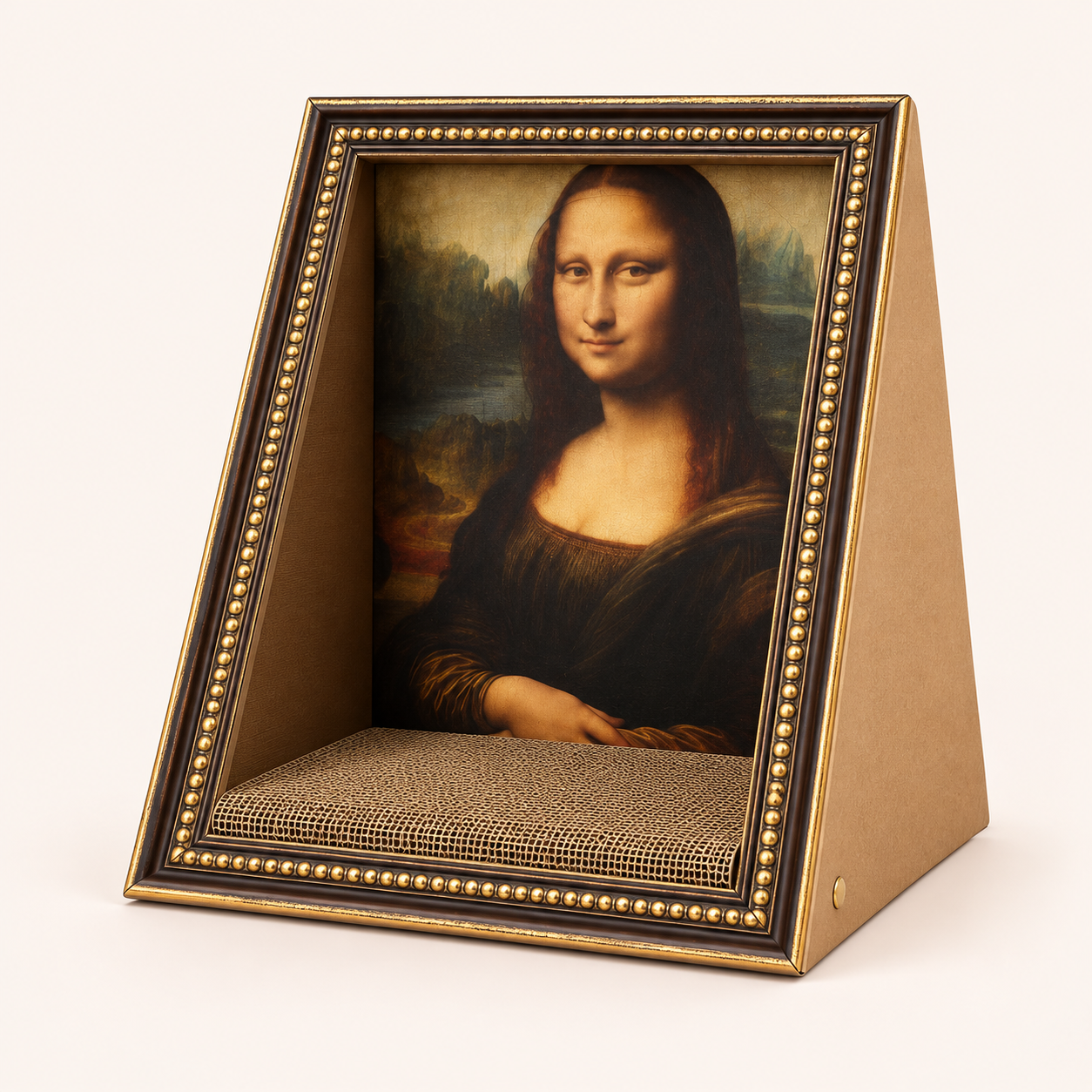
The Cat Scratcher House – Mona Lisa Picture Frame has a corrugated-cardboard scratching floor inside a sheltered frame. If your cat mainly stretches up a vertical sofa arm, it may also need an appropriate upright option. Choose for the observed action before choosing for the artwork.
2. Place the alternative where the choice happens
Start near the part of the room your cat already uses, with enough room to approach the entrance. Near the sofa does not mean pressed against a reclining mechanism or wedged behind a side table. Check the sofa's moving parts and your own walking route before positioning the house.
You are testing a useful choice, not setting a trap. Leave the entrance clear and let the cat investigate without being pushed inside. If it is ignored, record that response and reconsider access or orientation before treating the entire type of product as unsuitable.
3. Measure a working footprint
The Mona Lisa house measures approximately 44 × 34 × 52 cm / 17.32 × 13.39 × 20.47 in overall. Mark the width and depth on the floor, then add the approach space your own cat needs. The external measurements do not tell you the exact internal floor area or opening clearance.
The listing suggests cats up to approximately 7.5 kg / 16.53 lb, but body shape matters too. A weight suggestion does not replace checking whether a long-bodied cat can enter, turn and use the floor comfortably. Do not treat this floor-standing product as a wall-mounted climbing shelf.
4. Make sure the setup stays stable
Assemble the frame according to the product instructions and place it on a level, dry surface. Check that it sits securely before inviting investigation. A location that looks tidy but makes the house rock against a rug edge is worth reconsidering.
Keep a simple maintenance view: can you see loose cardboard, reach the scratching surface and clean the surrounding floor? Remove damaged or detached pieces when appropriate and check the structure. Cardboard wear is different from dirt on a water-washable fabric; the listing does not establish that this house can be soaked or machine washed.
5. Change one placement detail at a time
Try adjusting orientation or the approach route rather than moving the house to a new room after every quiet afternoon. This makes your observation easier to interpret. Note where the cat enters, whether it scratches or rests, and whether household traffic interrupts the visit.
If protecting a furnishing while you test the alternative, choose a method suitable for that furnishing and check it will not introduce loose pieces or adhesive problems. Do not move the cat's paws across the cardboard to demonstrate what it should do. Voluntary use is the response you are looking for.
6. Check what the decorative design includes
This listing is the Mona Lisa version only. The package contains the main body, three artwork background panels, a grayboard frame and the scratcher. Three background panels do not mean three complete houses, and a styled photograph does not add a cat or room props to the purchase.
| Observation | Placement response | Limit to remember |
|---|---|---|
| Scratches a sofa arm upright | Offer a suitable vertical option too | A cardboard floor is horizontal |
| Uses floor-level surfaces | Test accessible horizontal cardboard | Fit and stability still matter |
| Walks past the entrance | Review approach and household traffic | Artwork does not guarantee use |
Before you decide
- Observe horizontal and vertical scratching before choosing.
- Mark the external footprint and leave approach space.
- Check level placement, access and assembly.
- Treat the house as one product with included panels, not a multi-house set.
Common questions
Will this cardboard house stop my cat scratching the sofa?
There is no such guarantee. Appropriate surface type, access and individual preference all matter; persistent concerns may need advice beyond buying another object.
Is the 44 × 34 cm measurement the usable inside area?
No. The listing gives overall dimensions. Check the actual entrance and internal space for your cat rather than treating the external footprint as sleeping or scratching clearance.
Can I hang it on a wall or wash the whole house?
The current listing does not establish wall-mounting, a climbing-load rating or whole-house washing instructions. Use it according to its own product guidance.
Products mentioned
Written from published product details checked on October 27, 2026. Individual care and setup instructions still apply.